PROTECT IRISH HOMES FROM BANKS - HELP US DEMAND THE PROTECTION OF OUR GOVERNMENT - HELP US GET FAIRER USA STYLE SYSTEM
Today is a memorable day in Portugal. A IMF ECB EU TROIKA MAFIA Man was assaulted in Lisbon by portuguese Hero - Viriatus Lusitanus.
Why this is important
Irish Premier Enda Kenny described the homeowner debt crisis - following economic collapse; bursting of the property bubble and the treasonous merging of Sovereign and Banker Debt a the biggest national crisis facing Irish people since the Land Wars in the British Colonial Days of the late 19th Century. In Ireland there is no sharing of debt risk between the lender and borrower. However, Government is bringing in reasonably progressive new legislation on debt management BUT unbelievably are giving the Bankers a Veto on participation in its debt resolution processes. This will make the new law useless. Banks, through the courts are already evicting one homeowner per day. The present law disables a Judge from taking any circumstances into account other than the bank paperwork. This is unjust on a population of 4.5 million (2 million workforce - 800,000 mortgages) on which some €50 billion of Bank bailout debt has been placed and which will impoverish generations to come.
SIGN THIS PETITION
We ask that the new Insolvency Bill prioritises the protection of Irish homes, in line with the principles of social justice and common good enshrined in the Irish Constitution by leveling the playing field between banks and families. Bankers must not be given a Veto on participation in the debt resolution processes under the new Insolvency law. We urge you to change the existing law to allow Judges more flexibility in deciding on banker requested eviction orders and to consider shared risk in mortgage debt between the lender and the borrower.
TO be delivered to:
Enda Kenny, Taoiseach (Prime Minister), Republic of Ireland
be delivered to:
Eamon Gilmore, Tánaiste (Assistant Prime Minister) Republic of Ireland
#OccuparLisboa Portuguese #Revolution Protests Lisbon Portugal General Strike Precarios Inflexiveis movement Invasion On PT Contact Call-Cente
Portuguese movment take action on Portugal Telecom Call cente in Lisbon Portugal
Union-led marches are taking place in Portugal this afternoon, as part of today's general strike.
Word from Lisbon is that transport services have been badly hit by the general strike
The Lisbon subway, which carries more than a half-million passengers every weekday, stayed closed. Train, bus and ferry companies in the capital and the second-largest city Porto provided only occasional services. Long traffic queues built up on roads into both cities as commuters resorted to their cars.
There are also reports that most school children were sent home, because teachers and auxiliary staff did not show up for work, and that some medical appointments have been cancelled.
GCPW, which called the strike (more details at 8.16am). has more than 600,000 members, mainly public sector and manual workers.
But Luis Antonio, a plumber, said he was taking part (with his manager's blessing), and blamed Portugal's political class for the country's position
8.34am: There are reports from Portugal that the metro systems in Lisbon and Oporto, Portugal's second-largest city, have shut down because of the strike, and that the ferry service linking the two sides of the Tagus river in Lisbon is also suspended.
A worker, who is part of a picket line, stands in front of a train at the Rossio railway terminal in Lisbon as Thursday's general strike begins. Photograph: Rafael Marchante/Reuters
8.16am: Today's general strike has been called by Portugal's largest union, the General Confederation of Portuguese Workers (CGTP). It is opposed to labour law reforms, which remove restrictions on hiring and firing staff, and lowers the compensation payments due to workers.
CGTP, which has strong communist links, hopes that all major public transport services would join the stoppage, including trains, the Lisbon underground and the ferry boats that take workers across the Tagus River to the capital. That would mean that people could be unable to reach their workplace, even if they don't support the action.
3.51pm: The head of the Portuguese union that called today's general strike has vowed to press on with more industrial action in future, and admitted that today's turnout wasn't great.
Armenio Carlos, leader of the General Confederation of Portuguese Workers, said it was hard to persuade workers to down tools when they are already struggling to earn enough to survive.
He warned, though, that if Portugal risks disaster if it continues to impose tough austerity, saying:
This is the same path that was taken by Greece, which resulted in a huge failure.
Debtocracy is a 2011 documentary film by Katerina Kitidi and Aris Hatzistefanou. The documentary mainly focuses on two points: the causes of the Greek debt crisis in 2010 and possible future solutions that could be given to the problem that are not currently being considered by the government of the country.
The documentary has been distributed online under a Creative Commons BY-SA 3.0 license since 6 April 2011, and the production said that it has no interest in any kind of commercial exploitation of the project. The documentary is available in Greek and English and will be subtitled in at least 2 other languages. The production claims that half a million people saw the documentary in just the first 5 days of its release.
Name
The production team defines "debtocracy" as the condition by which Greece found itself trapped in its debt. The Greek term for debtocracy, Χρεοκρατία, has the same roots as the word for democracy. The term is coined from the Greek words "χρέος" (debt) and "κράτος" (power) in a similar manner that the word democracy is formed of the Greek words "δήμος" (people) and "κράτος" (power).
DEBTOCRACY (FULL - ENG Subs)
For the first time in Greece a documentary produced by the audience. "Debtocracy" seeks the causes of the debt crisis and proposes solutions, hidden by the government and the dominant media.
Editor/Script Katerina Kitidi
Aris Chatzistefanou
Scientific Research Leonidas Vatikiotis
Animation Magda Plevraki
Sokratis Galiatsakos
Music
Giannis Agelakas
Ermis Georgiadis
Aris RSN
Edit Aris Triantafillou
Camera Aris Papastefanou
ulia Reinecke
Coloring Thanos Tsantas
PR Michalis Alimanis
Contributors Aggeliki Gaidatzi
Fani Gaidatzi
Ioulia Kileri
Margarita Tsomou
Production Costas Efimeros
2011 - BitsnBytes.gr
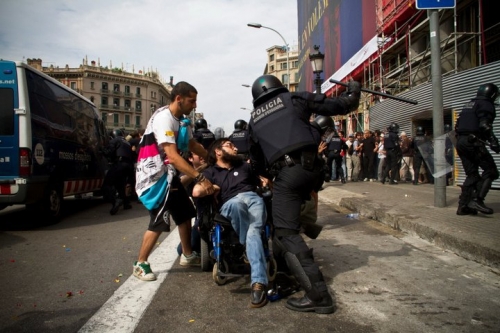
Information is still sketchy (if you’re in Barcelona, please give us an update!) but it appears that riot police have just cleared the peaceful protest camp at Plaça de Catalunya in Barcelona with force.
At least 43 are reported to have been treated for injuries, although actual numbers are likely to be higher.
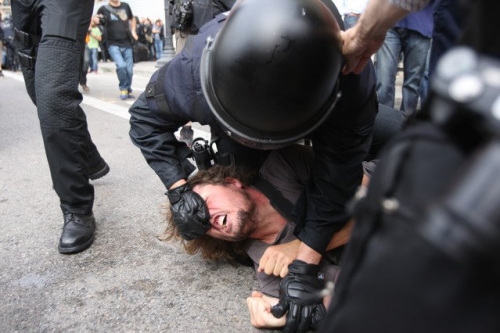
Video footage shows police beating away indiscriminately at protesters sitting on the ground. Reports say police even fired rubber bullets to disperse a small group of protesters that peacefully resisted eviction.
The Barcelona camp has been the second biggest in Spain, after the Puerta del Sol in Madrid, and had been occupied ever since the national protests on May 15th. Just yesterday, we shared a short documentary that showed the good-natured spirits of the peaceful protest camp.
The violent assault on peaceful protesters will only further reinvigorate the 15-M movement and boost the resolve of the Spanish youth uprising.
What had been a 12-day long peaceful protest against austerity, corruption and a lack of economic opportunity and political representation, today saw its first outbreak of violence, as Spanish riot police cleared out the incredibly positively-spirited protest camp at the Plaça de Catalunya in Barcelona.
But while the mainstream media spoke of ‘clashes‘ between protesters and police, the violence was really rather one-sided: the vast majority of the 120+ injured were peaceful protesters. While the people in the square wielded flowers, the police came crashing in wielding full-armor protective gear, batons, shields, pepper spray and rubber bullet shotguns.
Clearly, it was the stupidest thing Spanish authorities could have decided to do at this point. While the attack was explained as an attempt to ‘clean up’ the square ahead of tomorrow’s Champion’s League final, there were clearly ulterior (political) motivations behind the sheer brutality of the attack (I’ll let the images speak for themselves, no need to delve into this point any further).
The unprovoked violence of the ‘Mossos d’Esquadra’ will only further reinvigorate the determination of the 15-M movement to push for real democracy now. The popular Facebook group Spanish Revolution today posted the following ‘call to arms’ (although it was very clear to tell its followers to refrain from using violence and only to use passive forms of resistance and civil disobedience):
In this respect, there are a number of clear lessons to draw from the past. In their early stages, the Tunisian and Egyptian revolutions actually thrived because of the excessive use of force of the state security apparatus. The images of brutality helped radicalize large segments of the population that would otherwise never have engaged with the protests.
The exact same happened in Madrid last week. When riot police cleared some 150 peaceful protesters off the square in the night from Monday the 16th to Tuesday, the protesters — instead of backing down — came swarming back in the thousands. People just kept pouring into the Puerta del Sol until late in the night, occupying the square and still refusing to budge.
Today, while the international media was slow to pick up on the crackdown, footage of police brutality quickly spread around on social media. Facebook, Twitter and the blogosphere were abuzz with outrage at the entirely unprovoked and unnecessary violence, especially against women — and even a protester in a wheelchair carrying nothing but a flower in his hand.
Within hours, the Facebook group of the AcampadaBCN, which had previously counted only a few thousand members, boomed to over 38,000 followers. An online petition denouncing the police violence has already been signed by some 40,000 people. By the late afternoon, thousands of peaceful protesters had retaken the square and forced police into a humiating retreat.
Right now, as I write this on Friday night, tens of thousands of peaceful protesters have flocked to the Plaça de Catalunya to show their defiance and resolve. Now this is no longer just about idealism or changing the world. This is about preserving our most basic human rights to freedom, physical integrity and a dignified life.
y doing what they did, the authorities only confirmed what the 15-M movement has been arguing for almost two weeks now: “they call it a democracy and it’s not.” The movement will only swell in numbers. Now, more than ever before, it will have something to fight for, which is particularly important as the endless general assemblies of recent days had slowly begun to wear out morale.
This morning, the authorities showed that they’re afraid of us. The resort to violence is an attempt to exert physical authority in the absence of political legitimacy. They’re hoping to scare us off, to put the youth of Spain and Europe back in its place. But the genie is out of the box by now and any attempt to stuff it back in will only make it bounce back with even greater thrust and resolve.
Today, Spain, Europe and the world were handed the images of injustice that will become the very symbols of our peaceful resistance. This will only strengthen our resolve. La lucha continua. The revolution is only just getting started, and the people are back in control of the streets: