Web Toolbar by Wibiya
Showing posts with label European. Show all posts

Friday, 12 October 2012

European Revolution Portugal, Spain, Greece, Italy, Ireland: Southern Europe Must Revolt Against Price Stability; That Depends A Future of Prosperity Or Deep Depression"; Christopher T. Mahoney Ex-Vice President Moody's


Southern Europe Must Revolt Against Price Stability
It’s time for a revolution in the eurozone; the time for polite discussion has ended. What is at stake is not a percent or two of economic growth in the South, but rather the difference between a future of prosperity and a future of depression. The mindless happy talk of unity, solidarity and an ever closer union is now irrelevant and in bad taste. People are eating out of trash bins, and an entire generation is living on the dole.

European Central Bank Governors Meeting; Mario Draghi  Goldman Sachs Trilateral Bilderberg Bankster Boy ECB President Press Conference Transcript by  Christopher T. Mahoney Ex-Vice President Moody's


Article traslated in portuguese - Artigo traduzido em português

European, Revolution, Portugal, Spain, Greece, Italy, Ireland, Europe, Southern, Revolt, Prosperity, Future, Depression,


If the South continues to permit the North to administer the poisonous medicine of monetary deflation and fiscal austerity, it will suffer needlessly for years. Yes, we all know that the ECB was modeled after the Bundesbank and part of the deal for Germany was that the euro would be as strong as the mark. But that was then, and this is now.

The eurozone is a multinational republic in which no country, no matter how high its credit rating, can act as hegemon. Germany has just two votes on the ECB’s governing council, not control and not a veto. Germany is  just another member of the union, and the Bundesbank is just another regional branch of the Eurosystem. The ECB treaty was not intended as a suicide pact, and it can be interpreted liberally enough to permit what has to be done. If the constitutional court objects, then Germany can exit. She can’t force anyone else to.

The revolution must be led by France, Italy and Spain. They have already acted together at the last summit, when Monti refused to adjourn until Merkel made major concessions (since rescinded) about bank bailouts. These three men, Hollande, Monti and Rajoy, must form the nucleus of a bloc within the eurozone that demands open-ended QE until eurozone nominal growth rises to the mid-single-digits, and stays there.

First of all, there may already be enough votes on the governing council to ram QE through the Berlin Wall. Failing that, the bloc can refuse further austerity and threaten exit unless the ECB capitulates. Sadly, Mario Draghi is a cipher in all this, having sworn allegiance to the single mandate in order to get Merkel’s approval as president. He cannot lead the rebellion, nor would it be appropriate for him to do so.

What I am advocating is a public break with the Bundesbank and its ideological satellites, and a categorical rejection of minimal nominal growth and fiscal retrenchment. The Southern Bloc must demand nominal growth targeting, unsterilized bond-buying, and an end to self-strangulation by austerity. Those policies have been tried and they have failed for two years.

The South cannot balance its budget without inflation, nominal growth, and rising nominal government revenue. Structural reform is nice but at this stage quite irrelevant. Budget cuts and labor market reforms are not and must not be a prerequisite for nominal growth. Those are shibboleths unrelated to medium-term growth, and they would be much easier to implement in the context of growth.

Before this heart-rending tragedy is over the South will revolt, but probably when it is too late. The time is now, before Spain and Italy are forced to drink the Troika’s strychnine and arsenic. France, as a continental leader with market credibility, must lead this effort. Germany and its allies will think twice before going mano a mano with France.

The cost to the creditor powers will be higher inflation and a decline in value of their claims on the South, but that must occur one way or another. Inflation is much preferable to repudiation, which is the only other viable alternative.

Maybe it would be more prudent to conduct this revolt in private, but my sense is that it can only work as a public ultimatum. Europe successfully stared down Russia on many occasions during the cold war; she can do the same with Germany today.


Christopher T. Mahoney Profile


Mahoney Blog Capitalism And Fredom: Southern Europe Must Revolt Against Price Stability


Write About Or Link To This Post On Your Blog - Easy Links :
Link Directly To This Post :

Link To The Homepage :
Subscribe in a reader Follow rtotalglobal on Twitter

Enter your email address:

Delivered by FeedBurner

European Central Bank Governors Meeting; Mario Draghi Goldman Sachs Trilateral Bilderberg Bankster Boy ECB President Press Conference Transcript by Christopher T. Mahoney Ex-Vice President Moody's


Transcript Of Draghi's Press Conference: For the convenience of readers, Christopher T. Mahoney Ex-Vice President Moody's, have cleaned up the ECB's transcript of Draghi's Goldman Sachs European Central Bank President press conference, which followed the monthly meeting of the governing council.


Transcript in Portuguese: Transcrição da Conferência de Imprensa do Concelho de Governadores do Banco Central Europeu em Mario Draghi defende a política de estabilização de preços


European, Central, Bank, Governors, Meeting, Mario Draghi, Draghi, Goldman, Goldman Sachs, Trilateral Bilderberg Bankster Boy ECB President Press Conference, Transcript,  Christopher T. Mahoney, President, Moody's,

Introductory statement to the press conference and subsequent Q&A


Mario Draghi, President of the ECB,

Slovenia, 4 October 2012


Ladies and gentlemen, the Vice-President and I are very pleased to welcome you to our press conference. I would like to thank Governor Kranjec for his kind hospitality and express our special gratitude to his staff for the excellent organisation of today’s meeting of the Governing Council. We will now report on the outcome of today’s meeting.

Based on our regular economic and monetary analyses, we decided to keep the key ECB interest rates unchanged. Owing to high energy prices and increases in indirect taxes in some euro area countries, inflation rates are expected to remain above 2% throughout 2012, but then to fall below that level again in the course of next year and to remain in line with price stability over the policy-relevant horizon.

Consistent with this picture, the underlying pace of monetary expansion remains subdued. Inflation expectations for the euro area continue to be firmly anchored in line with our aim of maintaining inflation rates below, but close to, 2% over the medium term.

Economic growth in the euro area is expected to remain weak, with ongoing tensions in some euro area financial markets and high uncertainty still weighing on confidence and sentiment.


Our decisions as regards Outright Monetary Transactions (OMTs) have helped to alleviate such tensions over the past few weeks, thereby reducing concerns about the materialisation of destructive scenarios. It is now essential that governments continue to implement the necessary steps to reduce both fiscal and structural imbalances and proceed with financial sector restructuring measures.

The Governing Council remains firmly committed to preserving the singleness of its monetary policy and to ensuring the proper transmission of the policy stance to the real economy throughout the euro area. OMTs will enable us to provide, under appropriate conditions, a fully effective backstop to avoid destructive scenarios with potentially severe challenges for price stability in the euro area. Let me repeat again what I have said in past months: we act strictly within our mandate to maintain price stability over the medium term; we act independently in determining monetary policy; and the euro is irreversible.

We are ready to undertake OMTs, once all the prerequisites are in place. As we said last month, the Governing Council will consider entering into OMTs to the extent that they are warranted from a monetary policy perspective as long as programme conditionality is fully respected. We would exit from OMTs once their objectives have been achieved or when there is a failure to comply with a programme. OMTs would not take place while a given programme is under review and would resume after the review period once programme compliance has been assured.

Let me now explain our assessment in greater detail, starting with the economic analysis. Euro area real GDP contracted by 0.2%, quarter on quarter, in the second quarter of 2012, following flat growth in the previous quarter. Economic indicators, in particular survey results, confirm the continuation of weak economic activity in the third quarter of 2012, in an environment characterised by high uncertainty. We expect the euro area economy to remain weak in the near term and to recover only very gradually thereafter.

The growth momentum is supported by our standard and non-standard monetary policy measures, but is expected to remain dampened by the necessary process of balance sheet adjustment in the financial and non-financial sectors, the existence of high unemployment and an uneven global recovery.

The risks surrounding the economic outlook for the euro area continue to be on the downside. They relate, in particular, to ongoing tensions in several euro area financial markets and the potential spillover to the euro area real economy. These risks should be contained by effective action by all policy-makers in the euro area.

Euro area annual HICP inflation was 2.7% in September 2012, according to Eurostat’s flash estimate, compared with 2.6% in the previous month. This is higher than expected and mainly reflects past increases in indirect taxes and euro-denominated energy prices. On the basis of current futures prices for oil, inflation rates could remain at elevated levels, before declining to below 2% again in the course of next year.

Over the policy-relevant horizon, in an environment of modest growth in the euro area and well-anchored long-term inflation expectations, underlying price pressures should remain moderate. Current levels of inflation should thus remain transitory and not give rise to second-round effects. We will continue to monitor closely further developments in costs, wages and prices.

Risks to the outlook for price developments continue to be broadly balanced over the medium term. Upside risks pertain to further increases in indirect taxes owing to the need for fiscal consolidation. The main downside risks relate to the impact of weaker than expected growth in the euro area, in the event of a renewed intensification of financial market tensions, and its effects on the domestic components of inflation. If not contained by effective action by all policy-makers in the euro area, such intensification has the potential to affect the balance of risks on the downside.

Turning to the monetary analysis, recent data confirm the subdued underlying pace of monetary expansion. In August the annual growth rate of M3 decreased to 2.9%, from 3.6% in July. While this decline was mainly due to a base effect, monthly inflows were also relatively contained. Conversely, strong monthly inflows into overnight deposits contributed to a further increase in the annual rate of growth of M1 to 5.1% in August, compared with 4.5% in July. This increase reflects a continuing high preference for liquidity in an environment of low interest rates and high uncertainty.

The annual growth rate of loans to the private sector (adjusted for loan sales and securitisation) declined in August to -0.2% (from 0.1% in July), reflecting a decrease in the annual rate of growth of loans to non-financial corporations to -0.5%, from -0.2% in July. By contrast, the annual growth of loans to households remained unchanged, at 1.0%, in August. To a large extent, subdued loan dynamics reflect the weak outlook for GDP, heightened risk aversion and the ongoing adjustment in the balance sheets of households and enterprises, all of which weigh on credit demand. At the same time, in a number of euro area countries, the segmentation of financial markets and capital constraints for banks restrict credit supply.

The soundness of banks’ balance sheets will be a key factor in facilitating both an appropriate provision of credit to the economy and the normalisation of all funding channels, thereby contributing to an adequate transmission of monetary policy to the financing conditions of the non-financial sectors in the different countries of the euro area. It is thus essential that the resilience of banks continues to be strengthened where needed.

To sum up, the economic analysis indicates that price developments should remain in line with price stability over the medium term. A cross-check with the signals from the monetary analysis confirms this picture.

Other economic policy areas need to make substantial contributions to ensure a further stabilisation of financial markets and an improvement in the outlook for growth. As regards fiscal policies, euro area countries are progressing with consolidation. It is crucial that efforts are maintained to restore sound fiscal positions, in line with the commitments under the Stability and Growth Pact and the 2012 European Semester recommendations. A rapid implementation of the fiscal compact will also play a major role in strengthening confidence in the soundness of public finances.

At the same time, structural reforms are as essential as fiscal consolidation efforts and measures to improve the functioning of the financial sector. In the countries most strongly affected by the crisis, noticeable progress is being made in the correction of unit labour cost and current account developments. Decisive product and labour market reforms will further improve the competitiveness of these countries and their capacity to adjust.

Finally, it is essential to push ahead with European institution-building. The ECB welcomes the Commission proposal of 12 September 2012 for a single supervisory mechanism (SSM) involving the ECB, to be established through a Council regulation on the basis of Article 127(6) of the Treaty. The Governing Council considers an SSM to be one of the fundamental pillars of a financial union and one of the main building blocks towards a genuine Economic and Monetary Union.

We will formally issue a legal opinion in which we will, in particular, take into account the following principles: a clear and robust separation between supervisory decision-making and monetary policy; appropriate accountability channels; a decentralisation of tasks within the SSM; an effective supervisory framework ensuring coherent oversight of the euro area banking system; and full compatibility with the Single Market framework, including the role and prerogatives of the European Banking Authority. As the Commission proposal sets out an ambitious transition schedule towards the SSM, the ECB has started preparatory work so as to be able to implement the provisions of the Council regulation as soon as it enters into force.

We are now at your disposal for questions.
_____________________________________________________________

Question:
Two short questions, Mr Draghi. The first one: you mentioned downside risks to the economy again. Have there been any discussions today about a possible rate cut in the months to come?
And the second one on Spain: do you find Spanish bond yields appropriate at the moment or are they still hampering your monetary policy transmission?

Draghi:
On the first question the answer is no and on the second question, I will not comment.
But let me say one thing I forgot; Marko will answer questions about Slovenia today, so you will have to ask him about Slovenia.

Question:
Mr Draghi, was the decision to leave rates unchanged unanimous? That is the first question.
And the second is: what do you think about publishing the minutes much sooner than 30 years after the respective meetings?

Draghi:
On the first question, I would say that there was no discussion. So it was a unanimous decision about interest rates.

On the second question, clearly there have been statements by several Governing Council members and by myself showing an open mind with regard to this point; but it is a complex process and we are actually thinking about how to proceed. There are pros and cons. What you have to keep in mind is that the ECB is already a very transparent institution; just think about this press conference every month. There are also hearings in Parliament, interviews, speeches… I think that there are some benefits, as far as communication is concerned, to having greater transparency. At the same time, we have to evaluate and assess what this means in our specific context, the European context, which is different from that of the United States and the United Kingdom.

Question:
Mr Draghi, last month when you announced the OMTs, you said that matters were now effectively in the hands of governments. How concerned are you by the way that governments have responded? Some finance ministers have suggested that the ESM might not be covering legacy bank debts for instance, and Spain has still not applied for a bailout.
And my second question is on Greece: how would the ECB feel about rescheduling the repayments on the Greek bonds? Would that qualify as monetary financing?

Draghi:
On the second question, the answer is yes, it would qualify as monetary financing. We have said several times that any voluntary restructuring of our holdings would be monetary financing.

On the first question, I could say that today we are ready with our OMTs. We have a fully effective backstop mechanism in place, once all the prerequisites are in place as well. Governments have made substantial progress on a variety of fronts, both in what I call “vulnerable countries” and in countries that are under a full IMF programme. You can actually see this progress across the board as far as fiscal consolidation, structural reforms and also repairing some of the flaws of the banking sector are concerned. So, at this point, it is really up to the governments to decide what they want to do. The mechanism is in place.

Now to your question about the ESM: we will have to assess exactly what it means, and I do not want to prejudge the technical discussion that will take place. But we have to remember that this is not a matter for the ECB, it is a matter for the governments concerned; it is governments’ money, it is taxpayers’ money. So, they will have to discuss and take a stance on exactly what is meant by legacy assets.

Question:
Back to the OMT, you mentioned that there are steps that need to happen before the ECB would activate it. It is in the governments’ hands. Does that weaken the effectiveness of the OMT because you make yourselves part of the political process, which can be time-consuming and complicated?

And my second question is on the continued rise in youth unemployment in Europe and anti-austerity protests. How concerned are you about unemployment, youth unemployment and is austerity making the problem worse? Thank you.

Draghi:
The first question is about conditionality. We view conditionality as an essential part of the activation of the OMT. I have made this point since the very beginning. Conditionality will actually have several roles. First of all it will reduce the moral hazard by governments. The second role it will have is that it protects the independence of the ECB. Without conditionality you would certainly have what people call fiscal dominance. With conditionality the independence of the ECB is protected. There is also a third angle to this. You can look at conditionality as a way to create credit enhancement on the bonds of the country that is actually the object of conditionality. So, it is an incentive to pursue the right economic policies, which have benefits for all parties concerned. Now, there are going to be, and rightly so, some political processes, but look at this from another angle. You know that one of the conditions is the signing of a memorandum of understanding with the Eurogroup. Once you have that, you have unanimity. And you have the whole of Europe that is supporting this programme politically. By itself, this is an extremely forceful ingredient in the programme.

The second question was about youth unemployment. We completely share the concerns of the situation. And, as a matter of fact, in independent speeches several members of the Governing Council have raised the issue of high unemployment and especially focused on youth, on the young part of the population. It is an incredible waste of resources and it will have to be addressed and it can be addressed by properly reforming the labour market so as to decrease the dual nature the labour markets have taken, I would say in the last seven to ten years, in some European countries. The challenge, of course, is to address the dual nature of the labour market, while keeping it flexible overall.

Question:
Would a rate cut even be conceivable at the moment given that the transmission mechanism is broken and would there be any point in conducting such a thing until the OMT has been used or there has been a sustainable and significant drop in the bond yields of the countries that have distressed bond markets? Or is that an over-emphasis of the way you see this broken transmission mechanism?

And my second question. We are in Slovenia, at the spot where George W. Bush had his first ever summit with Vladimir Putin, after which Bush said he looked into Putin’s eyes and could see his soul and knew this was a man he could do business with. I was wondering if there was any such moment today between you and Mr Weidmann?

Draghi:
I would like to know from you who is Putin and who is George W. Bush?
Question:
I leave that to you.

Draghi:
On the first question, in a sense it is a purely hypothetical question. But it can be addressed by saying that non-standard monetary policy measures are being designed and implemented when the standard ones are not fully effective. Otherwise, we would simply stay with the standard policy measures. So, in a sense, this answers your question.

Question:
Can you carry on using standard measures at the same time as having to deploy non-standard ones?

Draghi:
Well, we have to see if we can repair the monetary policy transmission channels. We do not speculate on future changes in interest rates. I think that the Governing Council has assessed that the price level and the rate of change of prices is in line with medium-term price stability, according to our definition. So, that is the assessment we made about the interest rate and, as I said, there was no discussion.
But to answer your second question, while I do not want to comment on individual positions, of course, I can say that the discussion was very constructive across the board.
Question:
Mr Draghi, you keep encouraging banks to repair their balance sheets. Do you think that they should be able to use ESM funds for that, for their existing problems as well?
And my second question regards Spain: do you think that precautionary credit lines for Spain should be sufficient to solve Spanish financial problems?

Draghi:
On the first question: when I said there has been significant progress, I included the repair of bank balance sheets. The statement the President of the European Banking Authority (EBA) gave yesterday, when he presented the figures on the recapitalisation that has taken place so far, was reassuring in this respect. So, the capitalisation gap that was rather large until two years ago has been reduced significantly by the euro area/ European banks.
On Spain: it is one example where significant progress has been made. Significant challenges remain ahead as well, but the progress made on the front of fiscal consolidation, structural reforms (with the announcement of a very large reform programme), and on the front of the banking sector, with the conclusion of the stress test, is really remarkable if you think of just how many measures have been announced, legislated and implemented in such a short period of time.

Question:
Mr Draghi, just to follow up on that question. Does that mean that it would be enough for Spain to continue on its reform progress for the ECB to start buying bonds or would Spain actually have to commit to much harsher reforms for you to intervene?
And my second question would be: about a year ago, you said in a similar press conference that you would make periodic checks on whether you are in sync with the tradition of the Bundesbank or whether you are deviating from it. I was wondering what your assessment is today, whether you are in sync, or how close are you?

Draghi:
On the second point, I can answer right away that if the tradition of the Bundesbank was to ensure price stability, the ECB is fully in sync with that tradition.
On the first question, there is a tendency to identify conditionality with harsh conditions, as you said. Conditions do not necessarily need to be punitive. Actually, many of the conditions are related to structural reforms, which have social costs, but also great social benefits. And if the reforms are well designed, the latter are going to be greater than the former. So, whether this is enough is up to the Spanish Government to decide. It is for the other euro area governments to decide whether the programmes suffice – you know what the conditions are, you know that it is necessary to submit a request for an EFSF/ESM programme. We would actively seek the IMF’s involvement in the process. Having said that, we now have a mechanism in place that is a fully effective backstop if such a request comes and if the assessment of the Governing Council regarding the monetary policy transmission channels allows action to be taken.

Question:
I was wondering whether you could explain your thinking with regard to Portugal, because Portugal does look as if it has fulfilled the prerequisites for the OMT to work. So, why hasn’t the European Central Bank bought Portuguese debt on the secondary market?
And then one other question, because we are in Slovenia: the Slovenian Government is going ahead with the setting up of an institution to take over the non-performing loans from the banks in return for providing them with government bonds. Will those government bonds be eligible as collateral if the banks present them?

Draghi:
Portugal is an example of the significant progress that I have hinted at before, of the very, very significant progress that has been achieved. Moreover, the overall situation, politically speaking, is a strong situation. Obviously, we also fully share the concerns that have been expressed about the difficult social situation, but the reform agenda is firmly in place. The OMT would not apply to countries that are under a full adjustment programme until – and that is what I believe I said last time – until full market access, complete market access has been obtained. And this is because the OMT is not a replacement for a lack of primary market access. By the way, on this front, among several pieces of positive news that we have had in the last few days, we had one piece on Portugal, namely that, yesterday, for the first time, a three-year bond was issued, which is not complete market access, but it marks the beginning of complete market access, so that it is actually a reassuring bit of news.

Kranjec:
On Slovenia, you are right. The Parliament has adopted a law on the agency that will try to carve out bad assets from the banks. But the precise modalities for the eligibility of these bonds has not been decided yet, so that I am not able to tell you whether this would be acceptable or not. I can only tell you that the pool of collateral that is available to Slovenian banks at the moment is sufficient and that it is not an urgent matter. I understand that it will be elaborated in further steps on this law.

Question:
Have you seen any signs that the pure announcement of the OMT framework has affected the easing of credit conditions in the weak countries?
And my second question is, have you discussed what could be a good measure to decide what is an acceptable level of financial fragmentation and what is an unacceptable level?

Draghi:
On the first question, the answer is yes.

Question:
Sorry, because the figures of today, the August figures, show that especially in Spain it is getting worse.

Draghi:
There was a substantial, significant improvement all across financial markets and then there was a correction. If we take a snapshot now with respect to the beginning of August we see that the various interest rate spreads are still at a level way below where they were in July. We see one comforting piece of news, as I said before, about Portugal, having issued the first three-year bond. The second piece of good news actually concerns Spain, that Spain has completed almost 90% of its funding programme for the sovereign. There has been sizeable issuance by corporations and banks since then and, something that is dear to our eyes and we always look at: TARGET2 balances (or imbalances) have stabilised. All in all, the effect has been positive. There have been sizeable inflows of bank deposits in Italy. Spain’s recourse to central bank financing has gone down in the last month. Not bad, but at the same time we also have to express a note of caution. First of all, volatility is still relatively high and, secondly, governments will have to persevere in their reform action on all fronts: fiscal consolidation, structural reforms, the banking sector and more generally the financial market sector.
What is an acceptable level of fragmentation? Well, it is hard to say. But certainly when you see two subsidiaries of the same company located in two different countries and paying completely different interest rates for their borrowing, when you see exactly the same individual borrower, say a young couple that wants to buy a flat, and paying a completely different interest rate on mortgages, then you start asking yourself, maybe there is a problem here. Then you look around and you see that credit flows are normal in one part of the euro area, are non-existent in another part, falling and have been falling precipitously in yet another part. When you see that you have widespread credit rationing in some parts of the euro area, when you see that there is a very strange correlation between the movements in the exchange rates and the interest rates; namely that the exchange rate appreciates when the interest rates go down, and vice versa. When you see that the bid-ask spreads reveal a profound lack of liquidity in certain markets, when you see that levels of volatility are abnormally high and when you see that you have the inversion of the yield curves all of a sudden, which then disappears right after an announcement, then you say that you have a reasonable and possibly unacceptable level of fragmentation in the euro area. But the issue is really that the level of fragmentation becomes unacceptable when the singleness of the monetary policy in the euro area is being put into question. Because that is the time when we cannot achieve our primary objective, namely maintaining price stability in the medium term across the euro area.
Question:
I would like to return to the question of bad banks. The ECB had some concerns regarding the establishment of this agency or bank and I would like to ask you,
Mr. Draghi, whether this remark still stands or you support this, let’s say, resolution for Slovenia?
And the second question is, what are your recommendations for Slovenia regarding fiscal consolidation? Do you think that Slovenia needs a bailout?

Draghi:
I think Marko will respond best to both questions, but by and large let me say that we agree with the overall assessment of the IMF.

Kranjec:
Just to say a few sentences. The ECB made an assessment of the law that was adopted and we understood it in a sense that the view was that the agency, the government and the central bank should cooperate closely in deciding how to make the banking sector more resilient.
As to the second question regarding the bailout, I think it is much too early to say anything about it. All macroeconomic indicators at the moment point to the fact that if a country adopts decisive stabilisation measures in fiscal consolidation, in labour markets, in pension reforms and of course in the banking sector, it will not need to apply for a programme, but in the end, as the President also said, in many countries that is primarily a political decision. The central bank cannot operate in an environment which is inherently unstable from a macroeconomic point of view.

Question:
As a member of the Slovenian press, my question is rather similar. The decision on the OMT programme has contributed enormously to calming the situation in the markets. However, the yields on Slovenian government bonds remain rather high and surpass the yields of the Spanish government bonds. What do you believe are the factors that could calm this situation, which is very worrisome for Slovenian citizens?

Kranjec:
The spreads that you have noticed in the markets in our opinion do not reflect the fundamentals. You should take into consideration that the capital markets for Slovenian paper are very shallow, the transactions are rare and one cannot judge the underlying fundamentals from two or three transactions. We believe that with the adoption of the stabilisation measures that I mentioned before, spreads will go down and I understand – no I do not only understand, you can verify yourself – that spreads have gone down. With the adoption of further measures I believe that spreads will go down as they have done in other euro area countries.

Question:
Two questions. The first one: How concerned are you that if the OMT programme actually comes into action it might rearrange the yield curve and denaturalise the yield curve, as it were and frontload the short-end of the maturity spectrum?
The second one is on the OMT per se: If the OMT is a purely monetary measure for repairing the dysfunction of a fragmented market, how can you set political preconditions? Is it not a little bit like the local fire brigade telling me “ I can only turn on the water if you show me that you have a roof improvement programme”?

Draghi:
On the first point, we will certainly monitor the strategic response of the issuers to our programme. The OMT is not meant to induce a strategic response in favour of issuing short terms.. So this will be monitored. By the way, I think, and that is my purely personal perception, that all of the countries that may need an OMT have now reached, after many years of a difficult, very difficult process, reasonable maturities, reasonable durations in their stock of public debt. It is very unlikely they will change these durations in favour of a short-term issuance. First, because they have market access. It is not that they do not have market access. These countries do have market access. So there is no reason really to change the duration, and you know there are not only pros if you change the duration, you also have some serious cons. So all in all, I think it is unlikely. In any event the ECB will closely monitor this possible strategic response by issuers.
As to the second point, I think it is just the other way around. I think I did say something about this last time we had this press conference. When the OMT was designed, we had the perception and the evidence that there were tail risks in the euro area, namely that there was a bad equilibrium for certain countries in certain markets. It means that expectations were self-perpetuating and in the end would create disruptive scenarios. So then it is opportune for the policy-maker, which in this case is the ECB, to step in with a programme. At the same time, we should not forget how these countries got into a bad equilibrium to begin with, namely with bad policies, or in some cases no policies at all for a long period of time, while the rest of the world was changing completely. So the first conclusion was that any monetary policy would have no effect if the other policies did not change. That is why conditionality is so important. Eventually, as I said at the beginning, it is what makes the monetary policy effective and it is what protects the independence of the ECB. So I would not buy the example you have given, I think it is really an integral part of this.

Question:
Are you comfortable with the current situation in which Spain – and even Germany – has doubts about the rescue? Or did you expect a more rapid reaction from the political side?
And second, do you think that Spain has the possibility to resolve its crisis without European aid?

Draghi:
Unfortunately, I cannot comment on either of the questions, because stopping this process is very much a decision that is entirely in the hands of governments. As I have said over and over again, I think that through the OMT programme, the ECB has done everything possible and it could certainly create an environment which is conducive to reforms because it could remove what we call the redenomination risk. So, it could remove tail risks but ultimately, the initiative is in the hands of governments.

Question:
You spoke several times about risks and now redenomination risks. Yields have calmed down since your announcement in July and then your further announcement. How much of these risks have been removed and do you think it is just a temporary effect which will be reversed in the event that the OMT programme is not applied?
And second, as you made OMTs dependent on a request and the governments seem to be extremely reluctant to make such a request, and given that the monetary policy transmission mechanism is still broken, have you thought about any other solution that you could apply in this event?

Draghi:
Well, on the second question: for the time being, no. I think we have the sense that it was a very important decision which has many dimensions. We had to cope with all of these and it is now in place. We are ready and we have a fully effective backstop mechanism in place. Now it is really in the hands of governments and, as I said many times, the ECB cannot replace the action of governments.

With regard to whether the level of interest rates reflects redenomination risks, as I said before, we are considering a variety of indicators here, one of which is the interest rates and then we are also considering those I mentioned, namely the bid-ask spreads, liquidity, the shape of the yield curves and volatility. So there are a variety of indicators which will certainly inform our monetary policy assessment.

Question:
With regard to the recapitalisation of banks through the ESM, do you see any possible way out and if so, what is it?
And second, the markets are already discussing the point at which you could intervene in the markets in the event that Spain or another country asks for aid. Do you have a particular target or target range?

Draghi:
On the second question, the answer is no. As I just said, we are looking at a variety of indicators. And we will look at all of them because we have to carry out monetary policy assessment. What is the degree of disruption to our monetary policy transmission channels? That is simply a question we have to answer.
On the first question, as I said before, it really is very much in the hands of governments. They took the initiative a year and a half ago to create the ESM. Now that it is about to enter into force, there are certain limitations that are being brought to the table. There is going to be a political discussion and frankly, it would not be right for the ECB to prejudge the outcome of this discussion, nor to express views on it.

Question:
I would like to ask you a question on the supervision of banks: how do you plan to ensure that the two tasks to be performed by the ECB will be separated? In Germany at least, there are still important people who have many concerns about this potential conflict of interest. Jens Weidmann recently raised these concerns in an interview, so what would be your response?

Draghi:
I think there are very important concerns that we are addressing by means of a proper internal organisation. The proposal doesn’t give us much of an option on this. I think one of the principles I stated at the very beginning of this discussion was that, if in the end the ECB is involved in the single supervisory mechanism, we have to make sure we have an organisation which de facto assures the separation of monetary policy from supervision. And this can be done by fully delegating the task to the Supervisory Board. Fortunately, the Commission’s proposal does foresee the possibility of the Governing Council delegating all the supervisory tasks to the Supervisory Board. So, the management and internal organisational means are there. I believe it can be achieved.


http://capitalismandfredom.blogspot.pt/2012/10/transcript-of-draghis-press-conference.html#links

Living Europe’s Nightmare

NEW YORK – Losing a long war is always hard to accept. Hemmed in by the Americans and the Russians in the final days of World War II, Hitler convinced himself that he had two armies in reserve to mount a counter-attack and win the war. Meanwhile, having lost the entire Pacific, Japan’s Imperial Cabinet believed that no enemy could set foot upon the country’s sacred soil. When the truth is unimaginable, human psychology finds an alternative reality in which to dwell.

That describes the global situation today. The entire planet seems to be in denial about what is about to occur in the eurozone. Pundits keep expecting Germany to pull a rabbit out of the hat and flood the continent with Eurobonds, or that Mario Draghi will mount a coup at the European Central Bank and buy up every deadbeat country’s bonds.

Either could happen, but both are extremely unlikely. Germany cannot guarantee the eurozone’s debt without control over the eurozone, which no one has offered, and Northern Europe will not permit the ECB to be hijacked by “Club Med” and turned into a charity organization. It is not just a matter of politics; it is also – as the Germans keep pointing out – a matter of law.

Europe has a Plan A, whereby each country would reform its economy, recapitalize its banks, and balance its budget. But Plan A is not working: its intended participants, most notably France, are rejecting it, and there is an emerging southern European consensus that austerity is not the solution.

Greece’s recent election has put it in the anti-austerity vanguard. Italy and Spain (which does not have enough money to bail out its banking system), have similarly called for an end to austerity, and Ireland will be voting on it soon. All have lost access to the bond market, and Portugal is so far beyond hope that its sovereign debt is trading for cents on the euro.

There is no well-thought-out plan for the orderly exit of the eurozone’s insolvent countries. There are no safeguards, no plans, no roadmap – nothing. The Maastricht Treaty, like the United States Constitution, did not provide for an exit mechanism. So, instead of realism and emergency planning, we get denial and more happy talk. But, just because something is “unthinkable” doesn’t mean that it can’t happen.

In fact, it already is happening. Greece is rapidly running out of money; its residents are withdrawing their deposits and have stopped paying their taxes and utility bills. Even if the country can stay afloat until the June 17 election, a disorderly eurozone exit, default, and currency redenomination will follow. Greece will be dependent upon foreign aid for essential imports such as petroleum and food. Civil order will be difficult to maintain, and the army may be forced to step in (again).

Once Greece goes, runs on bank deposits are likely to follow in Spain and Italy. There is nothing to stop Spanish and Italian depositors from wiring their euros from their local bank to one in Switzerland, Norway, or New York. At that point, the only thing still standing between the eurozone and financial chaos will be the ECB, which could buy government bonds and fund the bank runs. The scale of such an operation would be enormous, and would expose the ECB to huge credit risk. But it could, in principle, step in – if Northern Europe permitted.

If the ECB does not step in, Italy and Spain, too, will be forced to exit the eurozone, default on their euro-denominated sovereign and bank obligations, and redenominate into national currency. Massive losses would be imposed on the global financial system. Given the opacity of banks’ exposures, creditors would be unable to discriminate between the solvent and the insolvent (as was the case in September 2008).

The US banks most likely to be affected by such a scenario would be the globalists: Citigroup, Bank of America, JPMorgan Chase, Goldman Sachs, and Morgan Stanley. They would require a rescue package similar to the US Troubled Asset Relief Program, created after Lehman Brothers’ collapse in 2008. The US can afford a second TARP, but it would require Congressional legislation, which is not guaranteed (though the US Federal Reserve can, of course, keep the system funded no matter what).

Massive wealth destruction, combined with global financial chaos, would pose a challenge to monetary policymakers worldwide. Central banks would be tasked with preventing deflation, implying a major round of quantitative easing. But, since banks are the transmission mechanism for monetary stimulus, this presupposes functioning banking systems. Each country would need to restore confidence in its banks’ solvency, which would most likely require a blanket bank guarantee and a recapitalization scheme (such as TARP).

The US financial system can withstand any shock, because the US can print the money that it needs. The Fed can maintain nominal prices, nominal wages, and growth if it acts heroically, as it did in 2008. The stock market will react negatively to the level of uncertainty caused by the collapse of the European financial system (as it did in 1931), and the dollar, yen, and gold should benefit. The fate of the British pound and Swiss franc is impossible to say; they could benefit as safe havens, but their banks are highly exposed to the eurozone.

It is bad enough that the world is utterly unprepared for the future that can be foreseen. The unanticipated financial, economic, and political consequences of the coming crisis could be even worse.

Em Português:

Reunião do Conselho de Governadores do Banco Central Europeu: Transcrição Conferência de Imprensa do Presidente  do BCE Mario Draghi  Goldman Sachs; Transcrito Por Christopher T. Mahoney Ex-Vice Presidente Moodys


Write About Or Link To This Post On Your Blog - Easy Links :
Link Directly To This Post :

Link To The Homepage :
Subscribe in a reader Follow rtotalglobal on Twitter

Enter your email address:

Delivered by FeedBurner

European Economic Crisis: "Living Europe’s Nightmare"; When The Truth is Unimaginable, Human Psychology Finds An Alternative Reality: The Entire Planet Seems To Be In Denial About What Is About To Occur In The Eurozone"; Christopher T. Mahoney Ex-Vice President Moody's


Living Europe’s Nightmare by Christopher T. Mahoney
Christopher T. Mahoney is a former Vice Chairman of Moody’s.
See Christopher T. Mahoney Full profile


NEW YORK – Losing a long war is always hard to accept. Hemmed in by the Americans and the Russians in the final days of World War II, Hitler convinced himself that he had two armies in reserve to mount a counter-attack and win the war. Meanwhile, having lost the entire Pacific, Japan’s Imperial Cabinet believed that no enemy could set foot upon the country’s sacred soil. When the truth is unimaginable, human psychology finds an alternative reality in which to dwell.

European, Economic, Crisis, Living, Europe's, Nightmare, Human, Psychology, Truth, Alternative, Reality, Planet, Christopher T. Mahoney, Eurozone,

That describes the global situation today. The entire planet seems to be in denial about what is about to occur in the eurozone. Pundits keep expecting Germany to pull a rabbit out of the hat and flood the continent with Eurobonds, or that Mario Draghi will mount a coup at the European Central Bank and buy up every deadbeat country’s bonds.


Either could happen, but both are extremely unlikely. Germany cannot guarantee the eurozone’s debt without control over the eurozone, which no one has offered, and Northern Europe will not permit the ECB to be hijacked by “Club Med” and turned into a charity organization. It is not just a matter of politics; it is also – as the Germans keep pointing out – a matter of law.


Europe has a Plan A, whereby each country would reform its economy, recapitalize its banks, and balance its budget. But Plan A is not working: its intended participants, most notably France, are rejecting it, and there is an emerging southern European consensus that austerity is not the solution.

Greece’s recent election has put it in the anti-austerity vanguard. Italy and Spain (which does not have enough money to bail out its banking system), have similarly called for an end to austerity, and Ireland will be voting on it soon. All have lost access to the bond market, and Portugal is so far beyond hope that its sovereign debt is trading for cents on the euro.

There is no well-thought-out plan for the orderly exit of the eurozone’s insolvent countries. There are no safeguards, no plans, no roadmap – nothing. The Maastricht Treaty, like the United States Constitution, did not provide for an exit mechanism. So, instead of realism and emergency planning, we get denial and more happy talk. But, just because something is “unthinkable” doesn’t mean that it can’t happen.

In fact, it already is happening. Greece is rapidly running out of money; its residents are withdrawing their deposits and have stopped paying their taxes and utility bills. Even if the country can stay afloat until the June 17 election, a disorderly eurozone exit, default, and currency redenomination will follow. Greece will be dependent upon foreign aid for essential imports such as petroleum and food. Civil order will be difficult to maintain, and the army may be forced to step in (again).

Once Greece goes, runs on bank deposits are likely to follow in Spain and Italy. There is nothing to stop Spanish and Italian depositors from wiring their euros from their local bank to one in Switzerland, Norway, or New York. At that point, the only thing still standing between the eurozone and financial chaos will be the ECB, which could buy government bonds and fund the bank runs. The scale of such an operation would be enormous, and would expose the ECB to huge credit risk. But it could, in principle, step in – if Northern Europe permitted.

If the ECB does not step in, Italy and Spain, too, will be forced to exit the eurozone, default on their euro-denominated sovereign and bank obligations, and redenominate into national currency. Massive losses would be imposed on the global financial system. Given the opacity of banks’ exposures, creditors would be unable to discriminate between the solvent and the insolvent (as was the case in September 2008).

The US banks most likely to be affected by such a scenario would be the globalists: Citigroup, Bank of America, JPMorgan Chase, Goldman Sachs, and Morgan Stanley. They would require a rescue package similar to the US Troubled Asset Relief Program, created after Lehman Brothers’ collapse in 2008. The US can afford a second TARP, but it would require Congressional legislation, which is not guaranteed (though the US Federal Reserve can, of course, keep the system funded no matter what).

Massive wealth destruction, combined with global financial chaos, would pose a challenge to monetary policymakers worldwide. Central banks would be tasked with preventing deflation, implying a major round of quantitative easing. But, since banks are the transmission mechanism for monetary stimulus, this presupposes functioning banking systems. Each country would need to restore confidence in its banks’ solvency, which would most likely require a blanket bank guarantee and a recapitalization scheme (such as TARP).

The US financial system can withstand any shock, because the US can print the money that it needs. The Fed can maintain nominal prices, nominal wages, and growth if it acts heroically, as it did in 2008. The stock market will react negatively to the level of uncertainty caused by the collapse of the European financial system (as it did in 1931), and the dollar, yen, and gold should benefit. The fate of the British pound and Swiss franc is impossible to say; they could benefit as safe havens, but their banks are highly exposed to the eurozone.

It is bad enough that the world is utterly unprepared for the future that can be foreseen. The unanticipated financial, economic, and political consequences of the coming crisis could be even worse.

http://www.project-syndicate.org/commentary/living-europe-s-nightmare


Write About Or Link To This Post On Your Blog - Easy Links :
Link Directly To This Post :

Link To The Homepage :
Subscribe in a reader Follow rtotalglobal on Twitter

Enter your email address:

Delivered by FeedBurner

Wednesday, 5 September 2012

Security Risks Assumptions On the Feasibility of Side-Channel Attacks With Brain-Computer Interface; This Appens With a 238 Euros, 300 Dolares VideoGames Equipment! Must Stop INDECT European Union Big Brother Agenda! Download Oxford Berkeley Universities Study Presented At Usenix Conference


Security Risks Assumptions Brain-Computer Interfaces Side-Channel Attacks Feasibility Threat Model EEG Devices Could be Abused To Capture Sensitiver Private Information Oxford Berkeleyy Genova Universities Study 12-final56


Security, Risks, Attacks, Equipment, Stop, Download, Study, Conference, Universities,  European, Union, Brother, Big, Agenda


On the Feasibility of Side-Channel Attacks with Brain-Computer Interfaces

Brain computer interfaces (BCI) are becoming increasingly popular in the gaming and entertainment industries. Consumer-grade BCI devices are available for a few hundred dollars and are used in a variety of applications, such as video games, hands-free keyboards, or as an assistant in relaxation training. There are application stores similar to the ones used for smart phones, where application developers have access to an API to collect data from the BCI devices.


The security risks involved in using consumer-grade BCI devices have never been studied and the impact of malicious software with access to the device is unexplored. We take a first step in studying the security implications of such devices and demonstrate that this upcoming technology could be turned against users to reveal their private and secret information. We use inexpensive electroencephalography (EEG) based BCI devices to test the feasibility of simple, yet effective, attacks. The captured EEG signal could reveal the user.s private informa- tion about, e.g., bank cards, PIN numbers, area of living, the knowledge of the known persons. This is the first attempt to study the security implications of consumer-grade BCI devices. We show that the entropy of the private information is decreased on the average by approximately 15 % - 40 % compared to random guessing attacks.

This  is possible ith a 238 Euros, 300 Dolares VideoGames Equipment! Must Stop INDECT;

Security Risks Assumptions Brain-Computer Interfaces Side-Channel Attacks Feasibility Threat Model EEG Devices Could be Abused To Capture Sensitiver Private Information Oxford Berkeley Genova Universities Study Download


Fonte :- https://www.usenix.org/


Write About Or Link To This Post On Your Blog - Easy Links :
Link Directly To This Post :

Link To The Homepage :
Subscribe in a reader Follow rtotalglobal on Twitter

Enter your email address:

Delivered by FeedBurner

Wednesday, 29 August 2012

European Union Economic Crisis; International Antibanks Resistance Petition Demands Ireland Government To Protect Irish People Homes Against Banksters Assault


PROTECT IRISH HOMES FROM BANKS - HELP US DEMAND THE PROTECTION OF OUR GOVERNMENT - HELP US GET FAIRER USA STYLE SYSTEM


Today is a memorable day in Portugal. A IMF ECB EU TROIKA MAFIA Man was assaulted in Lisbon by portuguese Hero - Viriatus Lusitanus.


Resistance, Antibanks, Ireland, International, Protect, Assault, People, Against, banksters,


Why this is important

Irish Premier Enda Kenny described the homeowner debt crisis - following economic collapse; bursting of the property bubble and the treasonous merging of Sovereign and Banker Debt a the biggest national crisis facing Irish people since the Land Wars in the British Colonial Days of the late 19th Century. In Ireland there is no sharing of debt risk between the lender and borrower. However, Government is bringing in reasonably progressive new legislation on debt management BUT unbelievably are giving the Bankers a Veto on participation in its debt resolution processes. This will make the new law useless. Banks, through the courts are already evicting one homeowner per day. The present law disables a Judge from taking any circumstances into account other than the bank paperwork. This is unjust on a population of 4.5 million (2 million workforce - 800,000 mortgages) on which some €50 billion of Bank bailout debt has been placed and which will impoverish generations to come.

SIGN THIS PETITION

We ask that the new Insolvency Bill prioritises the protection of Irish homes, in line with the principles of social justice and common good enshrined in the Irish Constitution by leveling the playing field between banks and families. Bankers must not be given a Veto on participation in the debt resolution processes under the new Insolvency law. We urge you to change the existing law to allow Judges more flexibility in deciding on banker requested eviction orders and to consider shared risk in mortgage debt between the lender and the borrower.

TO be delivered to:

Enda Kenny, Taoiseach (Prime Minister), Republic of Ireland

be delivered to:
Eamon Gilmore, Tánaiste (Assistant Prime Minister) Republic of Ireland

Avaz Petition: PROTECT IRISH HOMES FROM BANKS - HELP US DEMAND THE PROTECTION OF OUR GOVERNMENT - HELP US GET FAIRER USA STYLE SYSTEM


Write About Or Link To This Post On Your Blog - Easy Links :
Link Directly To This Post :

Link To The Homepage :
Subscribe in a reader Follow rtotalglobal on Twitter

Enter your email address:

Delivered by FeedBurner

Wednesday, 1 February 2012

European Economic Crisis Germany Debt: Over 575 Bilion Euros To Geek People: Petition Requesting German Government to Honor its Long-Overdue Obligations to Greece Repaying the Forcibly Obtained NAZI Fascist Occupation War Crimes Loan! Merkel Pay Now, or Abdicate German Sovereignty to Greece!


We will greatly appreciate your signature on our petition requesting the German government to honor its long-overdue obligations to Greece by repaying the forcibly obtained NAZI Fascist occupation loan (Over than 575 Bilion Euros), and by paying war reparations proportional to the material damages, atrocities and plundering committed by the German NAZI war machine during World War II.Please read the petition justification and the supporting materials provided here, on the botom of this website.


Justification
– In Detail

Germany Should Pay its
Long-overdue NAZI Obligations to Greece
Angela Merkel must shut her mouth and pay now with 300% more income, his NAZIS ancestors long debt to Greek people. Buy the away, Sarkonazy shut up and pay France Long debt6 to Portugal.

In the summer of 1940, Mussolini, perceiving the presence of German soldiers in the oilfields of Romania (an ally of nazi Germany) as a sign of a dangerous expansion of German influence in the Balkans, decided to invade Greece. In October 1940, Greece was dragged into the Second World War by the invasion of its territory by Mussolini. To save Mussolini from a humiliating defeat, Hitler invaded Greece in April 1941.

Greece was looted and devastated by the Germans bloody NAZIS, as no other country under their bloody NAZI occupation.

The German minister of Economics, Walter Funk, said Greece suffered the tribulations of war like no other country in Europe.

Justificação
– em detalhe

A Alemanha há muito que devia ter pago a divida dos NAZIS, pais de Angela Merkel que têm para com a Grécia.

Numa altura em que a Alemanha, na pessoa de Angela Merda, tanto exige a todos os outros povos da Europa que pagem já as pequenas dívidas é chegada a hora da ALEMANHA PAGAR O QUE DEVE E COM JUREOS.

A Alemanha de Angela Merda tem por dever pagar a enorme divida NAZI.É também chegada a hora da França do Sarkonazy pagar o que deve das invasões Francesas a Portugal.

No Verão de 1940 Mussolini, apercebendo-se da presença de soldados alemães nos campos petrolíferos da Roménia (um aliado da Alemanha), considerou isso um sinal perigoso da expansão da influência alemã nos Balcãs e decidiu invadir a Grécia. Em Outubro de 1940, a Grécia foi arrastada para a Segunda Guerra Mundial pela invasão do seu território. Para salvar Mussolini de uma humilhante derrota, Hitler invadiu a Grécia em Abril de 1941.

A Grécia foi saqueada e devastada pelos alemães nazis, antepassados da chanceler alemã, foi saqueada  e desvastada pelos NAZIS (antepassados de Merkel), como nenhum outro país durante a ocupação NAZI alemã. O Ministro Alemão da Economia, Walter Funk, assumiu que a Grécia sofreu as atribulações da guerra como nenhum outro país da Europa.

Upon their arrival, the Germans nazis, the Angela Merkel NAI ancestors, started to live off Greek country.

The Geman NAZIS, Angela Merekel ancestors, stolen, rob and appropriated everything, whatever they needed for their stay in Greece, and shipped all back to NAZI Germany.


The Germa NAZIS, Angela Merkel nazi ancestors, took, stolen, rob everything,  whatever they could lay their NAZI BLOODY hands on: foodstuff, industrial products, industrial equipment and stocks, furniture, heirlooms from valuable collections, paintings, archaeological treasures, watches, jewelry, and from some houses even the metal knobs from the doors.


The BLOODY GERMAN NAZIS, stolen and entire output of Greek mines: the German NAZIS rob all pyrites, iron ore, chrome, nickel, magnesite, manganese, bauxite, and gold was obtained for NAZY Germany. James Schafer, an American oil executive working in Greece, summed it up: “The NAZI Germans are looting for all they are worth, both openly and by forcing the Greeks to sell for worthless paper marks, issued locally” ( Mazower p.24).

Mussolini complained to his minister of foreign affairs Count Ciano “The NAZI Germans have taken from the Greeks even theirshoelaces”(Ciano p.387).


The massive NAZI looting of the country, the hyperinflation generated by the uncontrolled printing of German NAZI Occupation Marks by NAZI German local NAZI commanders, and the consequent economic collapse of the country, precipitated a devastating famine.

In addition to providing food for the 200,000 to 400,000 NAZIS Axis occupation troops stationed in Greece, the country was forced by German NAZIS (Angela Merkel ancestors) to provide the Axis forces involved in NAZI military operations in North Africa.

Greek fruits, vegetables, livestock, cigarettes, water, and even refrigerators were shipped by the German NAZIS, from the Greek port of Piraeus to Libyan ports under NAZI ocupation (Iliadakis p. 75).

The International Red Cross and other sources have estimated that between 1941 and 1943 at least 300,000 Greeks died from starvation (Blytas p. 344, Doxiadis p.37, Mazower p.23).

NAZI Germany and Italy imposed
on Greece exorbitant sums as occupation expenses to cover not only their occupation costs but also to support the German NAZI war efforts in North Africa.

As a percentage of GNP, these sums were multiples of the NAZI occupation costs borne by France (which were only one fifth of those extracted from Greece), Holland, Belgium, or Norway. Ghigi, the Italian plenipotentiary in Greece, said in 1942, “Greece is completely squeezed dry” (Mazower p. 67).

In an act of utter audacity, the German NAZIS occupation NAZI authorities forced the Tsolakoglou government to pay indemnities to NAZI German, Italian and Albanian nationals residing in occupied Greece for damages, presumably suffered during military operations, which were never defined.

The Italian and Albanian citizens alone received sums equivalent to 783,080 dollars and 64,626 dollars respectively! (Iliadakis p. 96). Greece, which was destroyed by the German NAZI Axis, was forced by German NAZIS (Angela Merkel ancestors) to pay citizens of its enemies for presumed but unproven damages.


In addition to the occupation expenses, NAZI Germany obtained forcibly from Greece a loan (occupation loan) of $ 3.5 billion. Hitler himself had recognized the
legal (intergovernmental) character of this loan and had given orders to start the process of its repayment. After the end of the war, at the Paris meeting of 1946 Greece was awarded $ 7.1 billion, out of $ 14.0 billion requested, for war reparations.


Italy repaid to Greece its share of the NAZI occupation loan, and both Italy and Bulgaria paid war reparations to Greece. Germany paid war reparations to Poland in 1956, and under pressure from the USA and the UK (to placate Tito and keep him from joining the Soviet block) paid war reparations to Yugoslavia in 1971.

Greece demanded from Germany payment of the occupation loan in 1945, 1946, 1947, 1964, 1965, 1966, 1974, 1987, and in 1995 (after the unification of Germany). Before the unification of Germany, using the London Agreement of February 27, 1953, West Germany avoided to pay its obligations arising from the occupation loan and war reparations to Greece on the argument that no “final peace treaty” had been signed. In 1964, German chancellor Erhard pledged repayment of the loan after the reunification of Germany, which occurred in 1990.

As the German magazine “Der Spiegel” wrote on July 23, 1990, with the Two (West and East Germany) Plus Four (USA, former Soviet Union, United Kingdom, and France) Agreement that paved the way for the German unification, the nightmare of demands for war reparations by all those damaged by NAZI Germany, which could be raised by signing a “peace treaty”, disappears.

This statement by Der Spiegel has no legal basis whatsoever, but it is an acknowledgement of the devices Germany is using to refuse a settlement with Greece (see also guardian.co.uk, June 21, 2011).

The same magazine, on June 21, 2011, quotes the economic historian Dr. Albrecht
Ritschl, who warns Germany to take a more chaste approach in the euro crisis of 2008-2011, as it could face renewed and justified demands for WWII NAZI German crimes reparations.


Indicative of the current value of the German obligations to Greece are the following: using as interest rate the average interest rate of U.S. Treasury Bonds since 1944, which is about 6%, it is estimated that the current value of the occupation loan is $163.8 billion and that of the war reparations is $332 billion.

The French economist and consultant to the French government Jacques Delpla stated on July 2, 2011, that Germany owes to Greece 575 billion euros from Second World War NAZI obligations (Les Echos, Saturday, July 2, 2011).

The NAZI BLOODY Germans (Angela Merkel ancestors) did not just take “even their shoelaces” from the Greeks. During WWII Greece lost 13% of its population as a direct result of the war (Doxiadis p 38, Illiadakis p 137).

During the Battle for Greece almost 20,000 enlisted Greek men were killed, and more than a 100,000 were wounded or frostbitten, while about 4,000 civilians were killed in air raids. But these numbers pale by comparison to the loss of human life experienced during the occupation.

According to conservative estimates, the deaths resulting directly from the war before the war ended adds up to about 578,000 (Sbarounis p. 384). These deaths were the result of the persistent famine, caused by the looting and economic policies of the Axis, and of the atrocities committed either as reprisals, as a response to the resistance, or as means to terrorize the Greek population.

The above number does not include the deaths which occurred after the end of the war from diseases such as TB (400000 cases) and malaria, from persistent malnutrition, wounds and exposure, all of them a direct result of war conditions. And the above numbers doesn't include this Greek economic bailouts, also consequence off Angela Merkel NAZI acestors Greek ocupation.

Thus, in WWII Greece lost as many lives, mostly of unarmed men women and children, as the USA and the UK together.

Most of the atrocities committed by the Germans NAZIS in Greece stemmed directly from two executive orders issued at the highest levels of the Third Reich.

According to the torching directive, issued by Hitler himself, if there was a suspicion that a residence was used by the resistance, that building was a legitimate target to be burned down with its inhabitants.

The second order, signed by Marshal Wilhelm Keitel, specified that for every NAZI German killed, a minimum of 100 hostages would be executed, and for every NAZI wounded one, 50 would die (Payne 458ff, Goldhagen pp 189-190 and pp 367-369, Blytas pp 418-419).

The first mass executions took place in Crete even before the island fell to the NAZI Germans.

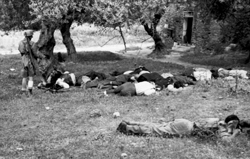
In 1945, under the auspices of the United Nations, a committee headed by Nikos Kazantzakis enumerated the destruction of more than 106 Cretan villages and the massacre of their inhabitants (see video on Kontomari massacre).

During the NAZI occupation, the NAZI Germans murdered the population of 89 Greek villages and towns (see the massacre at Distomo), while over 1,700 villages were totally or partially burned to the ground and many of their inhabitants were also executed by NAZI Germans (see the Greek Holocaust).

To the Greek victims of the German NAZI reign of terror should be added about 61,000 Greek Jews who, along with about 10,000 Christians, were deported by NAZI Germans (Angela Merkel ancestors) to the NAZI concentration camps and most of them never returned (Blytas p.429 and p. 446).

Another aspect of the Greek NAZI German occupation is the systematic looting of Greece’s many museums, both under orders from the occupation authorities, and as a result of the individual initiative of officers in position of command.

The names of German NAZI General von List, commander of the the 12th NAZI German Army, of NAZI German General Kohler, of the Larissa NAZI German command, and of General Ringel, of the Iarakleio and Knossos command, are associated with the removal of significant archeological treasures. List was responsible for accepting as a present a beautiful ancient head of the 4th century BC, while Ringel sent back to Austria several cases of antiquities from the historic Villa Ariadne as well as boxes containing small objects from the Knossos Museum. “Officially sanctioned thefts” have been recorded at the museums of Keramikos, Chaeronea, Thessaloniki’s St. George Museum, Gortynos, Irakleio, Pireaus, Skaramangas, Faistos, Kastelli Kissamou, Larissa, Corinth, Tanagra, Megara, Thebes and many others (Blytas p. 427).

What is especially tragic is that in many ofthese lootings, well known  German NAZI archeologists provided expert guidance to the perpetrators.

And although some of these antiquities were returned to Greece in 1950, the majority of the stolen museum pieces have never been traced.

In Crete and elsewhere, local nazi German commanders ordered the excavation and looting of many archeological sites. These excavations were carried out by nazi German archeologists, while Greek archeologists, curators and museum inspectors were forbidden to interfere, usually under NAZI threats which could not be ignored.

We request the German government to honor its long-overdue NAZI CRIMES obligations to Greece by repaying the forcibly obtained occupation loan, and by paying war reparations proportional to the material damages, NAZI atrocities and plundering committed by the NAZI German war machinery.

Sign the petition

À sua chegada, os nazis alemães (antepassados de Angela Merkel) começaram a saquear o país.

Os NAZIS, antepassados de Angela Merda, roubaram, pilharam e apropriaram-se de tudo o que necessitavam para a sua estadia na Grécia,  e despachavam para a Alemanha NAZI tudo aquilo a que conseguiam deitar a mão: alimentos, produtos industriais, equipamento industrial, mobiliário, objectos artísticos provenientes de colecções valiosas, pinturas, tesouros arqueológicos,
relógios, jóias, e até os puxadores
das portas de algumas casas. A produção completa das minas gregas de pirites, minério de ferro, crómio, níquel, manganésio, magnesite, bauxite e ouro foi enviada para a Alemanha NAZI. James Schafer, um executivo do petróleo americano que trabalhava na Grécia,
resumiu a situação: “Os NAZIS alemães estão a saquear tanto quanto conseguem,
tanto abertamente como forçando os gregos a vender em troca de marcos NAZIS de papel sem valor, emitidos localmente pelos NAZIS” (Mazower p.24). Mussolini queixou-se ao seu ministro dos negócios
estrangeiros, o conde Ciano: “Os NAZIS alemães roubaram até os cordões dos sapatos aos gregos ”
(Ciano p.387).

O saque completo do país, a hiperinflação gerada pela impressão descontrolada de Marcos NAZIS de Ocupação NAZI pelos comandantes locais alemães NAZIS e o consequente colapso económico do país provocaram uma fome devastadora na Grécia. Para além de alimentar os 200000 a 400 000 soldados de ocupação do Eixo NAZI estacionadas na Grécia, o país foi forçado a fornecer os NAZIS (antepassados de Angela Merkel) que estavam envolvidas nas operações NAZIS militares no Norte de África.

Frutos, vegetais, gado, cigarros, água e até frigoríficos foram roubados pelos alemães NAZIS (antepassados de Angela Merkel) e enviados do porto grego do Pireu para portos líbios ocupados peoos NAZIS(Iliadakis p.75).

A Cruz Vermelha Internacional e outras fontes estimaram que entre 1941 e 1943 pelo menos 300 000 gregos morreram de fome devido aos NAZIS (Blytas p. 344,
Doxiadis p.37, Mazower p.23).

A Alemanha NAZI e a Itália impuseram à Grécia somas exorbitantes como despesas de ocupação para cobrir não apenas os custos de ocupação NAZI, mas também para suportar os esforços de guerra alemães NAZIS no Norte de África. Como percentagem do produto nacional bruto, estas somas foram muito superiores aos custos de ocupação NAZI Alemã suportados pela França (apenas um quinto dos que foram pagos aos NAZIS pela Grécia), Holanda, Bélgica, ou Noruega. Ghigi, o plenipotenciário italiano na Grécia, disse em 1942, “A Grécia está completamente exaurida” (Mazower p. 67).

Num acto de abuso de poder, as autoridades NAZIS de ocupação forçaram o governo de Tsolakoglou a pagar indemnizações aos cidadãos NAZIS alemães, italianos e albaneses que residiam na Grécia ocupada por prejuízos, presumivelmente ocorridos durante as operações militares NAZIS.

Os cidadãos italianos e albaneses receberam somas equivalentes a 783 080 dólares e 64 626 dólares, respectivamente! (Iliadakis p. 96). A Grécia, que foi destruída pelo Eixo NAZI Alemão dos antepassados NAZIS de Angela Merkel, foi forçada pelos Alemães NAZIS a pagar aos cidadãos dos seus inimigos por alegados danos que não foram provados.

Para além das despesas de ocupação NAZI, a Alemanha NAZI obteve à força um empréstimo da Grécia (empréstimo de
ocupação NAZI) de 3500 milhões de dólares. O próprio Hitler conferiu carácter legal (inter-governamental) a este empréstimo NAZI e deu ordens para começar o processo de pagamento. Depois do fim da guerra, na reunião de Paris em 1946, foram atribuídos à Grécia 7100 milhões de dólares (dos 14000 pedidos) como reparações de guerra.

A Itália pagou à Grécia a sua quota-parte do empréstimo de ocupação, e tanto a
Itália como a Bulgária pagaram as reparações de guerra à Grécia. A Alemanha pagou as reparações de guerra NAZI à Polónia, em 1956, sob pressão dos EUA e do Reino Unido; pagou também reparações de guerra NAZI à Jugoslávia em 1971 (para aplacar Tito e evitar que ele aderisse ao Bloco Soviético). A Grécia exigiu o
pagamento da Alemanha em 1945, 1946, 1947, 1964, 1965, 1966, 1974, 1987, e em 1995 (após a reunificação da Alemanha).

Antes da unificação da Alemanha, utilizando o acordo de Londres de 27 de Fevereiro de 1953, a Alemanha Ocidental evitou o pagamento das obrigações decorrentes do empréstimo de ocupação NAZI e das reparações de guerra, usando o argumento que nenhum “tratado de paz final” tinha sido assinado. Em 1964, o chanceler alemão Erhard prometeu o pagamento do empréstimo após a reunificação da Alemanha, que ocorreu em 1990.

A revista alemã Der Spiegel escreveu, em 23 de Julho de 1990, que o acordo “Dois-Mais-Quatro” (assinado entre as duas Alemanhas e as quatro potências mundiais EUA, URSS, Reino Unido e França), ao preparar o caminho para a unificação alemã, fazia desaparecer o pesadelo dos pedidos de reparações que poderiam ser exigidos por todos os que tivessem sido prejudicados pela Alemanha NAZI, caso tivesse sido assinado um “tratado de paz”.

Esta afirmação do “Der Spiegel” não tem nenhuma base legal, mas é um reconhecimento dos estratagemas usados pela Alemanha para recusar um acordo com a Grécia (ver também o “The Guardian” de 21 de Junho de 2011). A mesma revista, em 21 de Junho de 2011, cita um historiador económico, Dr. Albrecht Ritschl, que aconselha a Alemanha a tomar uma atitude mais moderada na crise europeia de 2008-2011, uma vez que poderia enfrentar renovadas e justificadas exigências de reparações pelos crimes de guerra do periodo NAZI.


Os indicadores do valor actual das dívidas alemãs à Grécia são os seguintes: com base na taxa média de juros das Obrigações do Tesouro dos EUA desde 1944, que é cerca de 6%, estima-se que
o valor actual do empréstimo de ocupação NAZI seja de 163,8 mil milhões dólares e o valor da reparação de guerra seja de 332 mil milhões de dólares.


O economista francês e consultor do governo, Jacques Delpla, declarou, em 2 de Julho de 2011, que a Alemanha deve à Grécia 575 mil milhões de euros devido a
obrigações decorrentes da Segunda Guerra Mundial (Les Echos, sábado, 2 de julho, 2011).

Os alemães não levaram apenas “os cordões dos sapatos” aos gregos. Durante a Segunda Guerra, a Grécia perdeu 13% da sua população como resultado directo da guerra (Doxiadis p 38, Illiadakis p 137).

Em resultado da resistência à invasão do
país, quase 20.000 combatentes gregos foram mortos, mais de 100 mil foram feridos ou sofreram queimaduras com o gelo e cerca de 4.000 civis pereceram em ataques aéreos. Mas estes números são irrisórios quando comparados com a perda de vidas humanas durante a ocupação.

De acordo com estimativas moderadas, as mortes decorrentes directamente da guerra ascendem a cerca de 578 mil (Sbarounis p. 384).

Estas mortes foram o resultado da fome persistente, causada pelo saque e pelas políticas económicas do Eixo e pelas atrocidades cometidas tanto como represálias, como por resposta à resistência ou como meio para aterrorizar a população grega.

Os números acima não incluem as mortes que ocorreram após o fim da guerra devido a doenças como a tuberculose (400.000 casos) e a malária, desnutrição persistente, ferimentos e más condições de vida, todas elas resultado directo das condições de guerra, nem incluem os prejuizos da crise actual, também eles fruto da ocupação da Alemanha NAZI dos antepassados de Angela Merda.

Assim, na Segunda Guerra Mundial a Grécia perdeu tantas vidas, sobretudo homens desarmados, mulheres e crianças, como os EUA e o Reino Unido juntos.

A maioria das atrocidades cometidas pelos NAZIS alemães na Grécia teve origem diretamente em duas ordens vindas das mais altas esferas do Terceiro Reich.

Uma primeira, decidida pelo próprio Hitler, ordenava que se se suspeitasse que uma residência tinha sido usada pela resistência devia ser incendiada juntamente com os
habitantes.

A segunda ordem, assinada pelo marechal Wilhelm Keitel, especificava que, por cada NAZI alemão morto, um mínimo de 100 reféns seriam executados e por cada NAZI alemão ferido, 50 gregos morreriam (Payne 458ff, pp 189-190 e Goldhagen pp 367-369, Blytas pp 418-419).

As primeiras execuções em massa tiveram lugar em Creta, antes de esta ser tomada pelos alemães NAZIS.

Em 1945, sob os auspícios das Nações Unidas, um comité liderado por Nikos Kazantzakis enumerou a destruição de mais de 106 povoações de Creta e o massacre dos seus habitantes (ver sobre o massacre de Kontomari
[inglês]).

Durante a ocupação NAZI, os NAZIS alemães assassinaram a população de 89 aldeias e vilas gregas (ver sobre o massacre de Distomo
[inglês]), enquanto mais de 1.700 povoações foram total ou parcialmente queimadas e muitos dos seus habitantes também foram executados pelos NAZIS Alemães (ver Holocausto Grego
[inglês]).

Às vítimas gregas do reino de terror
alemão devem ser acrescentados 61.000 judeus gregos que, juntamente com 10.000 cristãos, foram deportados para campos
de concentração de onde a maioria nunca voltou (Blytas p.429 and p. 446).

Outro aspecto da ocupação Alemã NAZI (antepassados de Angela Merkel) à Grécia foi o saque sistemático dos muitos museus gregos, tanto sob as ordens das autoridades de cupação, como em resultado da iniciativa de oficiais que ocupavam posições de comando.

Os nomes do general Alemão NAZI von List, comandante do 12º Exército Alemão NAZI, do General Alemão NAZI Kohler, do comando NAZI Alemão de Larissa, e do general Alemão NAZI Ringel, dos comandos Alemães NAZIS de Iarakleio e de Cnossos, são associados ao desaparecimento de importantes tesouros arqueológicos. List foi responsável por aceitar como presente a escultura de uma cabeça esplêndida do século IV a.C., enquanto que Ringel enviou para a Áustria várias caixas de antiguidades da histórica Vila Adriana, assim como caixas contendo pequenos objectos do Museu de Cnossos.

“Roubos sancionados oficialmente” foram registados nos museus de Keramikos, Chaeronea, Museu de S. Jorge em Tessalónica, Gortynos, Irakleio, Pireu, Skaramangas, Faistos, Kastelli Kissamou, Larissa, Corinto, Tanagra, Megara, Tebas e muitos outros (Blytas p. 427).

O que é especialmente trágico é que, em
muitos destes saques, conhecidos arqueólogos alemães (NAZIS) forneceram orientação especializada aos perpetradores.

E embora muitas destas antiguidades tenham sido devolvidas à Grécia em 1950, a maior parte das peças de museu roubadas nunca foram encontradas.

Em Creta e noutros sítios, os nazis comandantes alemães locais ordenaram a escavação e o saque de muitos sítios arqueológicos. Estas escavações foram levadas a cabo por arqueólogos NAZIS alemães, enquanto os arqueólogos gregos, curadores e inspectores de museus foram proibidos de interferir, normalmente sob a forma de ameaças Alemãs NAZIS que não podiam ignorar.

Solicitamos que o governo alemão honre as suas obrigações (a divida NAZI dos antepassados de Angela Merkel) há muito atrasadas para com a Grécia, através do pagamento do empréstimo de ocupação que obteve à força e pelo pagamento das reparações de guerra proporcionais aos danos materiais, atrocidades e pilhagens feitas pela máquina de guerra alemã.

Assine a petição

Bibliography/Bibliografia
  1. Blytas, George C., The First
    Victory, Greece in the Second World War. Athens: Cosmos Publishing,
    2009.
  2. Ciano, Galeazzo, The Ciano
    Diaries, 1939-1943, Hugh Gibson Editor. New York: Doubleday &
    Co, 1946.
  3. Doxiadis, Konstantinos, Oi
    Thysies tis Ellados ston Deftero Pangosmio Polemo [The Sacrifices of
    Greece in the Second World War]. Athens: Ministry of Reconstruction,
    1946.
  4. Goldhagen, Daniel Jonah.
    Hitlers’ Willing Executioners, Ordinary Germans and the
    Holocaust. New York: Vintage Book, 1997.
  5. Iliadakis, Tasos, M., Oi
    Epanorthosis kai to Germaniko Katohiko Danio [The Reparations, and te
    German Occupation Loan]. Athens: Ekdoseis Detoraki 1997.
  6. Mazower, Marc. Inside
    Hitler’s Greece , The Experience of the Occupation 1941-1944.
    New Haven and London: Yale University Press, 1993.
  7. Payne, Robert. The Life and
    Death of Adolph Hitler. New York: Praeger Publishers, 1973.
  8. Sbarounis, Athanasios I.
    Meletai kai Anamniseis ek tou Defterou Pangosmiou Polemou. [ Studies
    and Memoires from the Second World War]. Athens: Government Printing
    Office, 1950″
This article is also in Revolta Total Global
    PDF
    Version / Versão em PDF

    Clique here to obtain a pdf version of this document. Spread it!
    para obter uma versão em PDF deste documento. Divulgue-a!

    Texto adaptado a partir de uma tradução do Aventar, a quem se deve a tradução deste texto, de inglês para português, mas não exactamente pelo seu conteúdo, uma vez que não verificáramm todas as suas fontes


    Write About Or Link To This Post On Your Blog - Easy Links :
    Link Directly To This Post :

    Link To The Homepage :
    Subscribe in a reader Follow rtotalglobal on Twitter

    Enter your email address:

    Delivered by FeedBurner

    Related Posts Plugin for WordPress, Blogger...